Two Ledgers, One Number: Reconciling a Pool Statement With a Power Bill
Every operator eventually sits with two documents that should agree and do not: a pool statement in BTC and a power bill in dollars. The mining side is deterministic. At 470 TH/s the credit is 0.00021084 BTC a day, $17.86 at $84,692 per BTC, or $0.744 an hour. The bill is where the surprises live, and the way to find them is to compare one month at a time.

Key takeaways
- 470 TH/s produces 0.00021084 BTC a day, which is $17.86 gross and $17.14 after the listed 4% on the block-reward part.
- Thirty days at that rate is 0.0063252 BTC, or $535.80, before power is counted at all.
- Hourly settlement under PPS+ means a statement can be audited day by day instead of month against month.
- Reconcile on three lines — gross credit, listed fee, power cost — and treat every other line as a query, not a given.
The statement and the meter never match on the first try
They should not match, and expecting them to is the first mistake. The statement counts coins credited per share submitted. The meter counts kilowatt-hours drawn at the wall, including fans, PSU losses and whatever else hangs on the same circuit. Two different quantities, two different units. A reconciliation that tries to make them equal will produce invented numbers on one side or the other.
What should match is a chain of three translations. Coins become dollars at a stated price. Dollars of revenue minus dollars of power gives a margin. Margin divided by kilowatt-hours gives a figure you can compare with the next site, the next machine or the next month. Keep the translations separate and a disagreement points at one of them instead of the whole pile.
Do the comparison in that order and something useful happens: the first line either agrees or it does not, and if it agrees the rest is ordinary cost accounting. Most operators start at the bottom, with the margin, and then argue about it without knowing whether the top line was ever right. Starting at the top costs one division and saves the argument.
Hourly credits make the audit cheap
PPS+ settles against current difficulty every hour, which is the detail that turns a monthly argument into a five-minute check. Take any day, divide the daily BTC by 24, and compare a handful of hourly credits with that figure. On 470 TH/s the expected credit is 0.000008785 BTC an hour. Three or four hours of agreement is enough to establish that the meter and the payout address are pointed at the same machine.
Where hourly credits fall short, the cause is usually uptime rather than rates: a reboot, a network drop, a fan failure that tripped a thermal limit. That is useful information for the power bill too, because a machine that stopped drawing power also stopped earning, and both sides of the ledger should show it in the same hour. Write the hour down when it happens; a note taken at the time is worth more than a reconstruction three weeks later.
The other use of hourly settlement is testing a change. Swap a PSU, move a machine, alter a power profile, and the next few hours will tell you whether output moved. With monthly settlement you would wait a month to find out, by which point the change is tangled up with a dozen others.
Reading the fee lines without double counting
The listed 4% is charged on the PPS-settled block reward. The transaction-fee component goes out on PPLNS logic at a listed 2% rate. If you model the whole payment as one pot and subtract 4%, you are close; if you subtract 4% and then 2% again for good measure, you are not. Pick the component, apply its rate, stop.
The ViaBTC Mining Guide spells out both schemes, and it is worth reading once with a pencil because the two components behave differently when the mempool is busy. Under PPLNS the choice is simpler: a listed 2% on reward and fees combined, paid after six confirmations, with the miner carrying the variance that PPS+ removes.
Thirty days at three hashrates
Scaling a single day up to a month is where small errors become visible on a bill. The table below runs the same inputs across three tiers, from a single machine to a small container share, and shows the coin total as well as the dollars so the two can be checked independently.
| Hashrate | USD per hour | USD per day | BTC per 30 days | USD per 30 days |
|---|---|---|---|---|
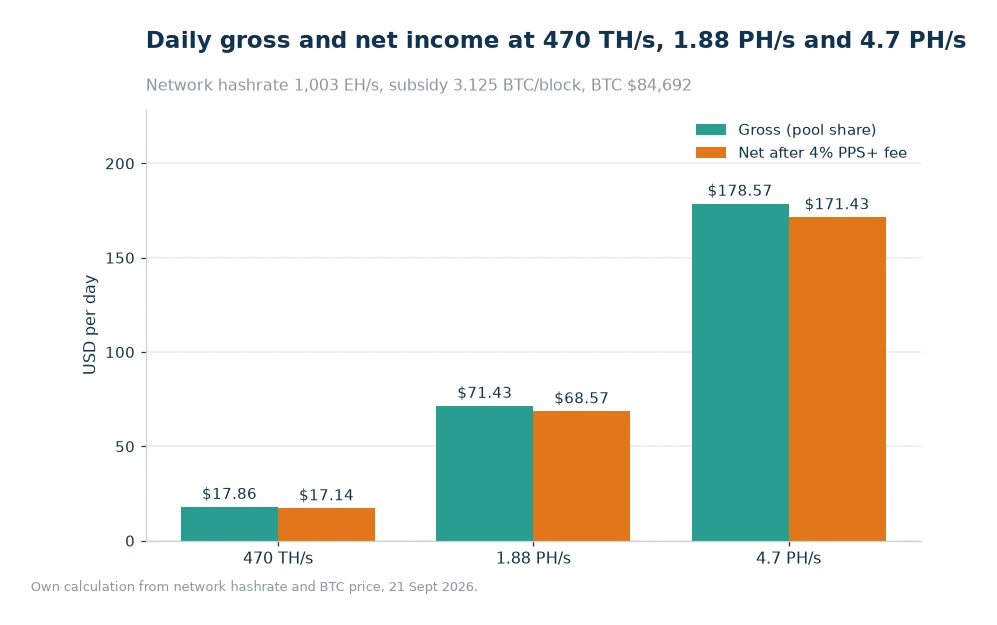
| 470 TH/s | $0.74 | $17.86 | 0.0063252 | $535.80 |
| 1.88 PH/s | $2.98 | $71.43 | 0.0253038 | $2,142.90 |
| 4.7 PH/s | $7.44 | $178.57 | 0.0632595 | $5,357.10 |
Worked example
Take the smallest tier and carry it from coin to coin, then to cash, then to a monthly total.
- Network output per terahash: 450 ÷ 1,003,000,000 = 0.0000004486 BTC a day.
- 470 TH/s × 0.0000004486 = 0.00021084 BTC a day.
- 0.00021084 × 84,692 = $17.86.
- 4% of $17.86 = $0.7144, so the net is $17.1456, reported as $17.14.
- Hourly credit: 0.00021084 ÷ 24 = 0.000008785 BTC, about $0.74.
- Thirty days: 0.00021084 × 30 = 0.0063252 BTC, and 0.0063252 × 84,692 = $535.80.
- The same day's fee, multiplied by 30, is $21.43, which is the line to look for on a statement before asking about anything else.
When the gap is real, and when it is rounding
A gap of a few cents on a $535 month is rounding, and chasing it wastes an afternoon. A gap of 3% to 8% has a cause, and there are only a few candidates: unrecorded downtime, a machine hashing below its nameplate, a statement covering 29 days rather than 30, or a price assumption on your side that is a day or two out of date.
A gap above 8% should stop the reconciliation until it is explained. In practice those come from power, not from coins: a second circuit nobody counted, a cooling unit on the same meter, or a tariff band that changes in the evening. The mining side is too simple to drift that far on its own, and that simplicity is what makes it a useful reference point.
Frequently asked questions
Should the pool statement and the power bill cover the same days?
They rarely do, because billing cycles start on different dates; align them by taking the daily credit of $17.86 at 470 TH/s and multiplying by the exact number of days in the power period.
Does a lower power bill change the coins I receive?
No. Coins depend on hashrate, network total and the listed fee, so 470 TH/s still credits 0.00021084 BTC a day; a cheaper tariff only improves the margin after that credit is converted.
How do I check the fee on a single day?
Multiply the gross credit by 0.04 for the block-reward component: at 470 TH/s, $17.86 × 0.04 = $0.7144, which matches the net of $17.14 shown in the chart.
Build the reconciliation once, reuse it monthly
Make a sheet with four columns: date, BTC credited, BTC expected, and power drawn. Fill it daily for one month. From then on the work is copying three figures and glancing at the difference, and the sheet will flag a failing fan before the invoice does. Add a column for the dollar price you used, so a later argument about margin can be settled by looking rather than remembering.
Two pages help at the edges: the multi-currency wallet keeps the credited coins and the payout history in the same account as the mining record, and Statistics gives the network figures you need for the expected column. Neither replaces your own sheet, but both shorten the loop between noticing a gap and explaining it.
Sources: ViaBTC scheme definitions and listed rates, wallet and statistics pages; chain inputs read 21 Sept 2026 — network hashrate about 1,003 EH/s, subsidy 3.125 BTC per block, 144 blocks a day, BTC $84,692. Published 24 Oct 2026. All figures assume 100% uptime and are arithmetic on those inputs[1].